Pages

Tuesday, February 28, 2012

Lonely Looking Sky


Lonely lookin sky
lonely sky, lonely looking sky
and bein' lonely
makes you wonder why
lonely looking sky
lonely looking sky
lonely looking sky

Lonely looking night
lonely night, lonely looking night
and bein' lonely
never made it right
never made it right
lonely looking night

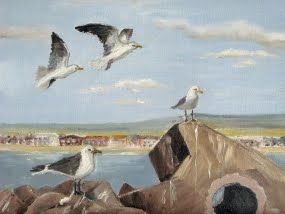
I mentioned Jonathan Livingston Seagull as the source of my title "Facts of Flight" for my three-part series of paintings. The series are finished and I will show the past painting in my next post. Doing these paintings, I am forever studying the shapes of seagulls. As it goes in nature, there are sometimes hundreds of gulls coming over one after the other a few meters from home. At other times, I have to walk a mile or two to stalk a single bird!

This morning I found some good examples of distant birds among my photos, and I hope you liked to see them accompanied by the lovely lyrics of Neil Diamond!

Sunday, February 26, 2012

Facts of Flight # 2, Paternoster


The three-part series which I started posting, were commissioned for the opening of a new gallery in the West Coast town of Hopefield. We'll be sleeping in a quaint B&B to be able to attend. Of course I will collect material for my blog too!

In the story of Jonathan Livingstone Seagull, it is said that seagulls never think about "the facts of flight"! Flight, graceful as it seems, comes automatically to the gulls, as their only concern in life is FOOD! That gave me the idea for the titles for this three-part series. This second painting shows the beach at Paternoster.

I am painting as hard as ever before! Having passed my 68th birthday made me feel that I should go faster! But the Internet has slowed down, I think it is due to the many users here in the outpost where we live. 25 Homes were allowed ADSL in the beginning. Now , without any improvements to the system there must be at least 150 people using it. I battle to visit blogs, and to comment I often get time-outs. One day we will catch up on the 21st century! This is just to say I still love all your interesting blogs!

Friday, February 10, 2012

Facts of Flight # 1


It seems nowadays that I cannot get enough of seagulls. I got up this morning at 5 to start planning some canvasses. Who me? Yup! I also went down to the rocks two nights ago to see them returning to their rocks. Seagulls leave in the late afternoon to drink water from a fresh source, such as the dams and rivers a few miles inland. On returning, their movements are at the most gracious as they glide in slowly towards their coming slumber. The guys I photographed in the sunset scene were still keen to dive down into the waves for morsels brought in by the strong tide, a little bedtime snack, I suppose!

The painting is somewhat similar to the one in the post about the dolosse. I love the juxtaposition of man-made boats, homes and dolosse with natural elements like rocks, water, clouds and birds. Painting size is 4oo mm x 4oo mm (15.7 " x 15.7 ") Oil on cotton wraparound canvas.


Friday, February 3, 2012

My Art is on the West Coast Route


I live on the West Coast, but now I am also represented in a much visited place along the route, the very special Nuweland Winery at Vyge Valley on the well-known R27 West Coast Route.

Today we hung 13 smaller works at Nuweland Winery and made wonderful plans for the future... including my participation in several Oyster Festivals and bringing in larger paintings! Invitations will follow!

Without much ado, here is the photo of the lovely venue for my art....with opening hours to suit everybody! That means seven days a week! For more info visit their website .

Sunday, January 29, 2012

Dolos, one amazing South African invention!


South Africans are naturally very innovative, and we are credited with some amazing inventions! Here I have painted one of the enormous dolosse along the Yzerfontein Harbour and jetty. They are made of concrete poured into a steel mould. So heavy are these structures that they are manufactured here in Yzerfontein or wherever they are needed. Cranes will lift them into place so that they can protect harbour walls and breakwaters and they also prevent soil erosion.10 000 dolosse are required for a kilometre of coastline.


I have to quote from Wikepedia here: "They work by dissipating, rather than blocking, the energy of waves. Their design deflects most wave action energy to the side, making them more difficult to dislodge than objects of a similar weight presenting a flat surface. Though they are placed into position on top of each other by cranes, over time, they tend to get further entangled as the waves shift them. Their design ensures that they form an interlocking, but porous, wall."Wow, the power of water and the cleverness of this invention!


Now, why are they called dolos ( plural: dolosse)? The form is similar to the neck bones of oxen. In the early days of our country, small children would pretend that these bones were their oxen to pull their tiny pioneer wagons. So they were called "doll oxen", which generated into the word dolosse.Then the word was also used to describe the bones thrown to read fortunes by the tribal medicine men, called sangomas. The act of predicting the future was more like "dobbel" which means "gambling". So those bones are still known as dolosse too.

These lovely structures, the theme of my painting and photos shows the third use of the word, and they do look like the neck bones of large animals. Grandson Philip was here from the States, and posed against the dolosse. He could not stop questioning his grandfather about these structures that can be stacked ANY WAY, yet they always fit together.


Elephant's Eye sent me their link to an interesting West Coast ramble that included a lot of information about dolosse. Read her blog HERE


After leaving a comment, you may want to visit some of our more important inventions HERE