Pages

Showing posts with label west coast blogger. Show all posts

Wednesday, November 2, 2011

The 2011 South African Blog Awards


The first leg of the 2011 South African Blog Awards end 7 days from now! Will you vote for me on that large red icon on the right?


This serene tableau at Saldanha Bay caught my eye. The little yacht seemed quite neglegted and not in use anymore. But how elegant are those lines!!! In real estate one often hears about a house advertised as "a decorater's dream". This could be the yachting equavalent!


We owned a yacht with a Lello form and sailed a lot, as I mentioned before, but don't ask me to count the rigging. I battled so much with those thin lines, there was no way on completing the painting that I was going to go back to see whether they were all there!


Don't forget to vote for me in "Travel" on the 2011 South African Blog Awards! (This is new to me, but we are actually encouraged to canvas for votes.....everyone is welcome to vote but only one vote per e-mail address is allowed)

Sunday, September 25, 2011

Waterblommetjies (Aponogeton distachyos)


Waterblommetjies also known as Cape pondweed, Cape hawthorn or Cape asparagus, is an ingredient in one of the most loved traditional dishes in the country called waterblommetjie-bredie (This word is a mouthful!!!!) While I lived briefly in other provinces of South Africa, I had to rely on the tinned products to make the popular stew. Here, of course, I am so close to many traditional food sources: only 90 km from where the bokkoms are harvested and a 3 minute walk from crayfish and other seafood. The nearest dams for harvesting waterblommetjies are on Lelieblom Farm in the Darling district. (The farm where I get so much material for my blogs!!)

I find that they appear in the markets more and more and this might mean that they will soon be available in fresh form all over the country. The ones I painted here were from a large fruit and veg market. The first people to utilize these greenish hard little flowers growing on long thin grass-like stems, were the Khoikoi people. They used it in stews, mostly with mutton, onions and potatoes and flavoured with salt, pepper and sorrel. Sorrel, of course grows in springtime so it is available at the same time as the waterblommetjies, and it is used to give a slightly acidic taste to the dish. I do not use the common garden sorrel at all, as it is much safer to have the plant positively verified by an expert. In fact, we will only eat it if three experts point them out! The little sorrel flowers on my cooked dish was placed there briefly for the photo!

Recipes? Just do what comes naturally. I always fry some onions first, then some lamb knuckles, add cubed potatoes and water, stock or wine and prepare for a slow simmer. Add the sorrel only if you know your garden weeds! The waterblommetjies are added last and steams on top of the dish as they soften and break up quickly. Mixed herbs, a little salt and some white pepper are a must. We find this dish filling and would eat it with salad things only, but rice is the traditional accompaniment.

For soup: Steam the waterblommetjies with potato and onion in a little milk and vegetable stock. Flavour with garlic and the usual dried herbs/salt/pepper. Liquidize, serve and enjoy this healthy vegetarian soup with some warm crusty bread.

I was unable to visit a waterblommetjie harvesting, but in the background I painted a man, knee-deep in water, harvesting the plants and putting them in a floating dish.


Tuesday, August 9, 2011

Awesome Sunsets


Sunsets at Kabeljoubank!!! Having lived here for so many years, our sunsets still remain a spectacular phenomenon! Is there some science, I often wonder, like the science that can measure sound to measure this burst of colour? Should there not be a formula by which I can measure the variety and intensity?

There are evenings when the waves stubbornly "ignore" the sunset and remains unmoved! Then again, like some weeks ago, everything was tainted pink, right up to the pebble-stones at my feet.

I posted some photos of our sunsets and by contrast, the sunset photo I took on the East Coast of Zanzibar last week! I realise that "Bambi Boerbok" has been on show on my blog far too long! Now you know where I've been! :-)

Wednesday, June 15, 2011

Shark in the Bay!!!!!


When I started this blog about the quiet West Coast of South Africa, I thought that I would really have to hunt for stories to tell and paint. I knew that I would sometimes have to squeeze a story out of a rock! Yet, so many things just happen. And here we have a shark in the bay a very short walk from my home!

The surprising thing is that one not usually expects sharks in such cold water! Yet we saw some monster through the binoculars one day while following the cormorants feeding. This is a baby whale shark of 6 meters long. We cannot determine why it died, but I am glad that the sea dumped it on this very quiet spot where it will not be crowded and prodded. We had only about two sunny days, so mostly a very cold tide washes over it and I hope that one of our big winter storms will return it to the ocean. Little Mitzi never blinked an eye and automatically accepted the large body in its final rest. What was truly strange was that she barked angrily every time the tide pushed in to wash over the shark!

Whale sharks have no teeth but their mouths are enormous grottos! I am so surprised by the bravery of West Coast fisherman going out on their small boats!

My quick sketch with white acrylic paint on black cartridge paper takes its style from the marks on the skin of the whale shark.

Monday, May 23, 2011

A Demo in Darling


We had Museum Day in Darling on Saturday, and I spent the morning demonstrating oil painting. I only had two days' warning so had little time to prepare. In my studio was a large seascape where the clouds and foreground had a rough underpainting in acrylics. It was done on a day when I wanted to put down a cold sky before I forgot what it looked like.

Behind my counter in the museum I followed the acrylic cloud shapes with oil paint, softening the edges. I showed how clouds were shaded with darker and lighter shades and how some sky colour had to be blended into the edges. I then painted the waves and used a type of very light calligraphy stroke to add lots of white foam edges to them. The rocks were then painted using only raw umber, ultramarine blue and white.

During the many years that I taught art, I have always tried to have some moments of tension to make my demo interesting. So, dipping my brush into the dirty brown colour of the rocks, I approached the wet completed sky. It took a few moments to squizzle in the seagulls and highlight them with white, but I could sense how people held their breaths as it was so easy to spoil the surface of my sky at that moment. Long hours on my feet, that I will not repeat soon, but it was wonderful to experience the company and the intelligent questions put to me by very young kids! Do children just get cleverer or what?

Thursday, April 28, 2011

Khwa Ttu # 4: How softly they tread!


There is no painting today but only photos. As heavy rains come down daily, accompanied by extreme cold, I stay indoors and ponder on what we know of the San.

Signs of their lives which go back thousands of years were found in this whole area stretching over Yzerfontein and Darling and at the present !Khwa Ttu. Even here where I live close to Kabeljoubank one of those mysterious rounded stones with the hole in the centre was found when the neighbours laid their foundations.

How very softly they treaded, these gentle people, the first inhabitants of the Cape! They did not excavate or build or cultivate or plant! They truly left the earth as they found it! What they needed in their daily lives was only a little food and water, and some protection for the body. My few photos show all the possessions they needed. With bow and arrow the men followed and killed buck, which they cut into pieces with flintstones. They made "Boy-scout fire" and some meat and vegs were cooked. (On the tour that I will take on a sunny day, we are going to be instructed in making a fire with two sticks, oh my, I am going to fail class!)

The women and girls collected medicinal and edible plants and roots, using the heavy stones as levers on their sticks to lift out underground tubers. The San valued water most highly and collected it underground by means of grass straws pushed down into melon-like watery roots. Water could also be stored in ostrich shells and carried around like quivers by using leather straps. All clothing and blankets were made of animal skins. The only other thing they needed was entertainment, which took place in the form of stories en-acted by the elders.

Once an area was depleted of food, the San would move away, but they were not nomads in the full sense of the word, as they would gladly settle in a good spot, like here at !Khwa Ttu, The Place of Water, with many little discoveries still in store for us... (To be continued)

Saturday, April 2, 2011

!Khwa Ttu # 1: The Approach


For the next few posts I am taking you to !Khwa Ttu, a 15 minute drive from home. You may pronounce it Qwatoo, as few of us could master the clicking sound preceding the word. Here the San has dwelt many centuries ago. While people in Europe built palaces and kingdoms, ships and new world colonies, the San survived through their miraculous talents of hunting and finding food in drought-struck savannas and deserts of the Southern regions of Africa.

The approach goes though fields with a desolate feel to it, only familiar to us who were born and bred in Africa. I have tried to portray this sense of Africa in my oil painting. Even hardy fynbos was trampled by these early people and the wild animals they hunted. I am gripped by a feeling of longing as we drive towards the entrance. What stories of survival are hidden here? To be continued........

Friday, March 11, 2011

Daydreaming on the Berg River


Like children everywhere, the local West Coast children must get their education. But
as this little man admires a newly painted boat, his thoughts are with the real men on the deep ocean. He imagines himself pulling out a heavy net brimful of the little mullet, a plentiful fish which assures that nobody will grow hungry. He wants to stay here, work the ocean and keep a happy home full of laughter and song!

Sadly for him, the opportunities to work in and on the West Coast are not plenty as the rules and quotas for fishing become more severe.

Regular readers of my blog will recognize this scene as one of the many private jetties off Bokkom Lane near Velddrif. Being an admirer of the work of Catherine Jeffrey, I made sure of putting down the tonal values first. Once that was done, the completion was much too fast, but I will leave it at that and see how the next painting turns out.

Some happy landmarks this week: I passed 3000 unique South African visitors and 2000 Americans as well as a total of over 19000 hits.(click on Pageviews on my flag panel to see this) My blog's second birthday is 20 days away. By the way, South Africans, who are you? You are welcome to make appointments to visit my studio, seriously!!! A few people have done that and we had a super time!

Sunday, February 27, 2011

A West Coast Studio


A lovely week started with a sale of 5 paintings from my French Belles series. Those were the first sales of this year. This event was followed up with a good clean-up! I needed to re-plan my work space and decided to get all my framed works on the wall as the frames get knocked all the time when they lie around. Here are photos of the completed studio.

My large collection of History of Art books are not in this room, only practical books and art magazines. You can see the work triangle formed with two antique tables where I have a small easel for sitting down, and a large one for standing. The tables are also ideal when grandchildren visit. (Alas, they all live far away) I cover them with plastic table cloths and the kids do what they like. Old paintings get a layer of gesso and become their canvasses. I keep all my old brushes for that reason too.

Friday, February 18, 2011

The Restless Ocean - completed


This is the first painting that really gave me heart palpitations. It is both restless and restful! I drag it from room to room in my house. In some areas it looks far too bright, too turquoise, and in a different location it looks serene and calm!

For the last couple of years, I have taken the sea for granted, because every window on two sides of the house have a view. Now, I cannot pass a window without really staring. Since yesterday I have picked up a lot of detail that is NOT in this painting, but will be in the next. For instance: the white foam on the summit of the wave has a shadow of its own, like snow, it is not just white. Also, there is green in the large waves, not my soft peppermint whisper of a colour, but a ferocious darkish green. There is so much to learn!

These photos show the completed painting 1000mm x 750mm. I include some details in the post too, because the seagulls lifting up from the rocky outcrop was such a delightful detail, I had to do it well. There is variation in the colours of the photos too: too much blue sky when I shot them. Our best photos are taken on overcast days.

Saturday, December 4, 2010

Purple Ragwort (Senecio arenarius)


I am painting the last of the purple ragwort flowers of the season! Because I water my garden twice a week some of them survived a bit longer than they would in the field.

Ragwort make a wonderful display in springtime, colouring the fields around us to a purple landscape. The flowers are pretty but poisonous to humans and livestock as it is said to affect the liver. Yet my beloved voles, which I painted a few months ago, are vegetarians and find ragwort such a treat. It is just too cute to see the flowers in those little hand-like paws! I have found that if you move past a window or stir a curtain the voles are gone! They are extremely sensitive. Maybe the early morning sun blinded them a little this morning, so I stood behind the glass and got the photos I have been yearning for. I hope to invest in a telephoto lens for my camera, to catch some better shots in future. In the meantime I present Mr and Mrs Vole eating their purple ragwort breakfast.

I also paint these purple flowers to celebrate my brand-new purple blogspot : French Belles by Marie Theron. (http://frenchbelles.blogspot.com/) Be sure to visit this blog and see me having fun with small paintings and fashion!

Wednesday, November 17, 2010

The Fiscal Shrike


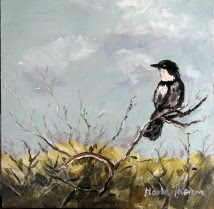
I took a photo of the lovely program for the Slice of Life Exhibition. How neat the gallery looks! This show with it's mass of even-sized paintings will run until the 21st of January 2011. I hope to receive some news about my set of birds! I could have painted 5 gannets and 5 of seagulls, but am so fond of sets of four, that I filled the remaining two blocks with something different. So here is the image of my little shrike.

As you know, there are no trees here on the West C0ast, so all the small birds around here perch themselves on top of the bushes that we call "fynbos". The fiscal shrike is such a cute round little creature as he scans the world all around for insects. I have never came upon a fiscal shrike larder here, but as a child we had a barbed wire fence and my dad would call us every time he found a larder....oh my, what a grizzly experience that was for a little girl!!! But I never missed a chance to see crickets, worms and grasshoppers impaled on pieces of barbed wire, left there to dry in the breeze like our fisherman do with the snoek and bokkoms!

Do you know the Fiscal Shrike? It lives all over our country, but this little one was sitting only a few meters from the ocean.

Tuesday, November 2, 2010

More and more Gannets!


By now I think everyone must realize that I cannot let go of the gannets of Lambert's Bay. Suddenly I see seabirds in my future as an artist: going into more and more detail and entering the world of Wildlife Art by painting the precious and protected birds of the West Coast.

The great exhibition of 630 works by 63 artists, called "A Slice of Life" opens this week in Somerset West. On the 10 wooden blocks I received, I used 4 for my gannets. I showed one piece last week, and here are the three others. You can see how they all look together in the first photo.