Pages

Showing posts with label SA west coast tourism. Show all posts

Sunday, July 6, 2014

The West Coast and I


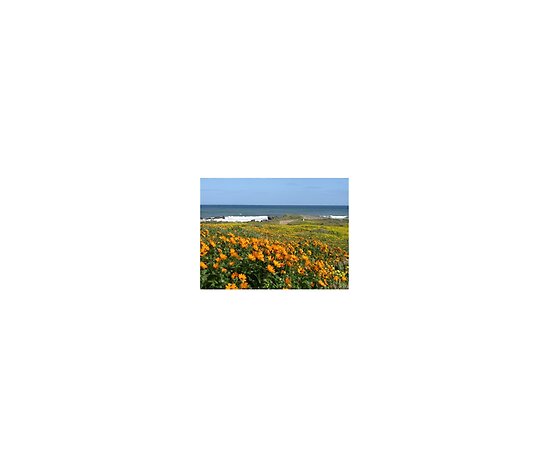
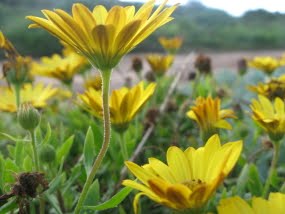
Ten years ago we moved to the West Coast to live close to the ocean. How close? Friends who have seen photos of my home, will know! The photos in this post were taken 80  meters from where I live by friend and photographer Mary Ann Bosch, who absolutely loves the West Coast too. 

In May last year, I lost my husband and  although I bravely declared that I would remain here forever, I slowly started to identify my new role. So I am making a shift to warm Natal where we have lived before, and where my twin granddaughters are.   I will not make any move in haste. I was never a person to be hurried along, but yes, I am gradually taking leave and getting new plans together. I keep a wide space in my heart for the West Coast and for the lovely memories we have collected.


.


Sunday, February 26, 2012

Facts of Flight # 2, Paternoster


The three-part series which I started posting, were commissioned for the opening of a new gallery in the West Coast town of Hopefield. We'll be sleeping in a quaint B&B to be able to attend. Of course I will collect material for my blog too!

In the story of Jonathan Livingstone Seagull, it is said that seagulls never think about "the facts of flight"! Flight, graceful as it seems, comes automatically to the gulls, as their only concern in life is FOOD! That gave me the idea for the titles for this three-part series. This second painting shows the beach at Paternoster.

I am painting as hard as ever before! Having passed my 68th birthday made me feel that I should go faster! But the Internet has slowed down, I think it is due to the many users here in the outpost where we live. 25 Homes were allowed ADSL in the beginning. Now , without any improvements to the system there must be at least 150 people using it. I battle to visit blogs, and to comment I often get time-outs. One day we will catch up on the 21st century! This is just to say I still love all your interesting blogs!

Wednesday, November 2, 2011

The 2011 South African Blog Awards


The first leg of the 2011 South African Blog Awards end 7 days from now! Will you vote for me on that large red icon on the right?


This serene tableau at Saldanha Bay caught my eye. The little yacht seemed quite neglegted and not in use anymore. But how elegant are those lines!!! In real estate one often hears about a house advertised as "a decorater's dream". This could be the yachting equavalent!


We owned a yacht with a Lello form and sailed a lot, as I mentioned before, but don't ask me to count the rigging. I battled so much with those thin lines, there was no way on completing the painting that I was going to go back to see whether they were all there!


Don't forget to vote for me in "Travel" on the 2011 South African Blog Awards! (This is new to me, but we are actually encouraged to canvas for votes.....everyone is welcome to vote but only one vote per e-mail address is allowed)

Sunday, October 16, 2011

Sutherlandia frutescens or Cancer Bush


A wonderful perk of travelling is getting to try the food of different nations! I think armchair travelling is the same and I found much joy in all the comments I received about waterblommetjies, a traditional dish of the Cape! Now, from food to medicine as I introduce the amazing centuries-old cure, Sutherlandia frutescens, locally known as cancer bush.

Having heard so much about this bush and having noticed it in health tablets, I set off to !Khwa Ttu to buy the plant for my garden. I was lucky, there were saplings for sale! Not only that, but in the indigenous garden the plants were in bloom. The restaurant at !Khwa Ttu also had pots of them as flower arrangements, nicely labelled with info about the plant.

According to the booklet "Gathering Fynbos" written by San experts 2 handfuls of dried leaves and young stems should be added to cold water and boiled for half an hour. One should drink a small glassful once a day. It is claimed to be a great immune booster and beneficial as preventative or cure for pancreatic cancer, aids, kidney disease, diabetes 2, arthritus, fever, gout , urinary tract infection and for treating the mother after delivery. Remember, the San and Khoikoi people for centuries survived without Western medicine!

I needed some good neutral opinion and was pleased to find a very informative website official-looking and honest and never trying to over- glorify the plant. I took this paragraph from their site.

Quality-of-Life Tonic

There is preliminary clinical evidence that Sutherlandia has a direct anticancer effect in some cancers, and also acts as an immune stimulant, but Sutherlandia should not be recommended as a so-called “universal cancer cure”, but rather as a quality-of-life tonic.

  • Mood
    Sutherlandia decreases anxiety and irritability and it elevates mood.
  • Appetite and weight
    It is an established fact that up to a third of cancer patients succumb to the wasting syndrome, rather than the actual tumor mass. Appropriate doses of select chemotypes and varieties of Sutherlandia dramatically improves appetite, and weight-gain can be expected in wasted patients. The first 5 kg gain is common after six weeks of treatment. In patients who are not wasted, weight-gain is not usual.
  • Energy levels and exercise tolerance
    Sutherlandia typically improves the energy levels and exercise tolerance of patients, and gives an enhanced sense of well-being.
The website has all the newspaper and medical reports one can wish for, for those interested in more info about Sutherlandia. If you come across it in health tablets in the States or UK or anywhere, I would love to know! I hope my little plant will thrive so that I can brew some elixir!

The painting was done in watercolours on 300gms watercolour paper. Those rhythmic little stems and the large pea-like red flowers were a tempting subject, tempting enough to make me reach my watercolour paints.

Saturday, June 4, 2011

There is Nothing like Farm Food


The West Coast is well known for unique eating-out experiences. Some restaurants just offer a beach shelter commonly built from natural vegetation as protection from the elements; others offer equally rough-and-ready indoor experiences. One of the most popular is the Boesmanland Farm Kitchen on lovely Langebaan Lagoon. Good food is the main thing here, more important than any props, crockery or glossy interior design. We were lucky when our friends booked a Sunday lunch here. They live overseas and move in diplomatic circles. They have been everywhere in the world, but for them the true local and ethnic experiences are of primary interest.

We each found a sawn-off log with a piece of army blanket as seating, and were given a stack of paper plates and a plate holder. The idea is to go back for more food as many times you like. We started with the famous bread made from fresh homemade potato yeast and baked in the wood-fired oven. The food is made in the traditional way in large black pots over open fires. There are traditional snoek (fish) dishes available, but I had to skip those to indulge in "boontjie-bredie" with mutton as an ingredient.

A nice local touch was the singing duo who went from table to table, singing at the tops of their voices.The kids in the lounge were very thrilled to hear the popular local songs with the occasional Lady in R-edddddddd and other requests (and innovasions) thrown in.

My painting shows the preparations for true farm coffee which will be accompanied by koesister, (also called koeksister), a local sugar syrup-dipped plaited dumpling. I loved painting this blackened oven, it gives such an old atmosphere to the place.

Saturday, April 2, 2011

!Khwa Ttu # 1: The Approach


For the next few posts I am taking you to !Khwa Ttu, a 15 minute drive from home. You may pronounce it Qwatoo, as few of us could master the clicking sound preceding the word. Here the San has dwelt many centuries ago. While people in Europe built palaces and kingdoms, ships and new world colonies, the San survived through their miraculous talents of hunting and finding food in drought-struck savannas and deserts of the Southern regions of Africa.

The approach goes though fields with a desolate feel to it, only familiar to us who were born and bred in Africa. I have tried to portray this sense of Africa in my oil painting. Even hardy fynbos was trampled by these early people and the wild animals they hunted. I am gripped by a feeling of longing as we drive towards the entrance. What stories of survival are hidden here? To be continued........

Sunday, March 6, 2011

Bokkom Lane


A row of quaint old buildings meanders along on the bank of the beautiful pristine blue Berg River. A developer with a sharp business eye might think "aha" and see visions of malls and playgrounds. Luckily for us, this little lane is strictly protected and regarded as a national treasure. The street had looked like this for hundreds of years and will continue to be the place where a age-old custom of drying sardines is still practiced.

I have blogged extensively about Velddrif and its bokkoms, and new readers may want to catch up, so I will lead you there: On the first anniversary of my blog, I showed the photogenic little fish in Bokkoms at Velddrif. I then showed the dried product and how I personally enjoyed my bokkoms in Bokkoms turning from Silver to Gold. As part of a set of four paintings for an architect's beach home, I also showed characterful Janine who worked at one of the factories in my post called Folks and Fish #3

My current painting shows part of the dirt road with little bokkom factory-shops. I show 4 tourists, but on a normal day that will be 3 too many! More people should become interested in the old customs and try to enjoy the living history of the West Coast!

Monday, January 17, 2011

It is good to be back!


Every year our beloved West Coast seems to get more and more popular. The R27 can become so congested that it is hard to get onto that road when we need to. Locals just burrow in and stay put, but we decided to go away this year. So 5000km by car, many sights in this lovely country, and many visits and adventures later, I am back! I enjoyed the Waterberg area tremendously and that is where I got bitten by a tick! (News travel fast and I sincerely thank everybody who wished me a speedy recovery from the tick-bite fever!) We also visited Johannesburg, Pretoria, Bloemfontein, Durban and Plettenberg Bay.

Today I am surely cured and feeling well! I made two paintings this morning under which I could sign the new date 2011. Both paintings have the elements that make up the West Coast: sky and sea, rocks and sand and fynbos. We have magical summer days at the moment! It is good to be back!

Thursday, November 25, 2010

Happy Thanksgiving


A year has passed and again I break away from the West Coast theme to wish my American children and friends Happy Thanksgiving. My daughter Helen in Texas is cooking up a storm for her family and friends. I enjoyed Thanksgiving so much when I was there in November 2000. Ah, the yams, oven-baked with layers of apples in between, really complemented the turkey which my sun-in-law baked in an outside oven! Spending very little on "props and flowers", she always creates a most beautiful table setting. Yesterday she told me: " Mom, we embrace this holiday, because there are always so much to be thankful for!"

The friends I want to send these wishes to are the few I know in person and the many kind people I have met and chatted with in the blogging world and the social media. I include the over 1600 secret and very silent US people who have visited my blog the last eighteen months. Enjoy, everyone!

This painting of a very South African-looking pumpkin farm is part of about 10 paintings I made when I was still planning my blog, then of course I decided on another formula of smaller and historically correct works. So these paintings have not been framed or exhibited. They fit nowhere in my oevre, but Mitzy the Maltese thinks that they do give some colour to her corner!

Sunday, November 7, 2010

A Slice of Life Exhibition


After all the anticipation to attend the opening, the day of week, the time of day and the great distance prevented me from attending the opening of the exhibition. Avril who owns the gallery wrote so well about it on the morning after that I am going to quote him here: " Difficult to describe unique events like these. Crazy, ridiculous, exciting, enjoyable, all at the same time. Maybe "memorable" is a fair description. Many, many guests and few serious problems. One of those events one has to attend to really appreciate.
Since the gallery opened for business on 20 September 2007 I always wanted to do a real "opening", where the paintings are "unveiled". And this was the golden opportunity to do it. Imagine the curtains coming down and 600 paintings becoming fully visible all at once. I enjoyed the exercise, and according to all accounts most guests did!

In my photos this week I show my ten works together, followed by all my seagull paintings.

Living here next to the coast, I can see a lot of individualism in the seagulls. The leaders, the lookouts, the extremely young and the old and overweight birds all represent themselves...Again I "humanize" them, which I cannot help. Look at the gull I was able to get very close to....he really thought the rope was a safeguard against an approaching human. Then there is the group who seems to wait for a signal from their leader, something like: On your marks, get set, GO! I hope you enjoy my seagull paintings!

Saturday, October 23, 2010

The West Coast at Springtime


I have been working on 10 paintings for an exhibition and finished the last one yesterday! They are all West Coast themes and meant for an invited show of 63 artists each doing 10 paintings of the popular 8 x 8 size. "A SLICE of LIFE "Exhibition will show all 630 paintings on one gallery wall!

Before I start blogging and chatting about these completed works, I would love to show my favourite photos of the coastal flower displays not far from my home during Springtime.

Tuesday, October 19, 2010

Gardening on the West Coast


In planning a West Coast garden, I decided to take my cue from the surrounding veld. There are no trees in the pristine fynbos, so I did not plant any. This is not a coast of waving palm trees and huge tall plants, and I often see people planting them because they love trees/want shade/want birds/need something tall as a focal point, or for whatever reason. But surely one would then attract the wrong sort of birds, because our Cape Robins, Francolins and Black Oystercatchers sleep on the ground or in low vegetation.

Another rule would be to have no flowers that will self-seed and start spreading into the fynbos. Nasturtiums are a no-no! I plant so that there is always a great display of colour. This is a long narrow garden and I want colour as far as the eye can see. By not trimming and allowing plants to grow together there are never any weeds as there is no room for them. Because of harsh rainless summers you need plants that do not need a lot of water. We are planning to make some "green" plans this year to water the patch of lawn.

In the photos you will notice that I allow the wild pelargoniums, sorrel, watsonias, Livingstone daisies (bokbaai vygies), all types of aloes and ragwort to grow where they want to. I make no division between wild and cultivated plants.

My garden has been photographed by many people who can see it over the walls, and are thrilled by all the colour! This is a garden where I only spend about 4 days working in a year, while the buffalo grass grows vertical and needs trimming about every third week only.

Monday, September 13, 2010

Fear of Flying?


This post comes to you from Pretoria where my West Coast exhibition takes place this week. The last week before leaving I painted enough gannets, photographed them and put them on disc. How easy it is to put your work in your purse nowadays!! The same cannot be said of all the paintings we hauled up here!

The time watching the gannets from the bird hide on Bird Island at Lambert's Bay was one of the most exciting times of my life. One can never get enough of that lovely mass of soft yellow heads, interspersed with the black "Pacman"-like, feature-less baby gannets! Soon, however, I started focussing on the spectacle of their flying.

The soil where they trample around is very hard, and they have a strip that they use for taking off, with many bodies actually walking through it. So to find a clear few yards to run before rising from the ground is difficult. Again and again they try, lose courage or halt to avoid a wanderer in their way and go back to try again. Flap-flap goes the feet designed for swimming over the hard crusty earth. I promise you that an onlooker can become utterly nervous! The eventual take-off is not very smooth but quite faltering!

On the edges, where the rocks are, others peek over the precipice before throwing themselves into the air. There are akward moments when they almost hang in the air, trying to find the proper movements. As if my readers are not upset enough by this time, I also have to tell you that the landings on those enormous feet looks like a great plopping down! I was saddened but not surprised to read in Nelson's book on seabirds that some gannets can injure or kill themselves in flying accidents! Here, close to the earth they have their worst close shaves with danger.

But of course, what takes place in the first moments of alighting is absolutely forgotten the moment they stretch out in the air, and form a single line from beak to tail, while the wings unfold to an enormous, finely tipped wingspan. Suddenly they are the most gracious and effective of flyers who are able to divebomb the sea at such a speed that it carries them down a full ten meters to a supply of fish who never saw it coming! Yeah, for the gannets, can you feel the relief and freedom of those flyers as they do the auronautical tricks they were born for.


Sunday, June 13, 2010

Folks and Fish # 1


This is the first painting of a set of four works, of which I have shown the preparatory sketches in the previous post. Working at them I am conscious of the poverty of the area and the plight of those brave souls, the sustenance fishermen, who face the sea day by day.

My model shows two of the four crayfish he is allowed to catch for his daily quota during the crayfish season. It will be safer for the men to catch the monthly allowance in one single day, and not face the sea so often, but unfortunately such a system will be difficult to control. (Crayfish can become very scarce and must be protected.)

Crayfish holes are marked by experienced fishermen, who will put on diving suits and retrieve their quota. Older people and non-swimmers can catch theirs by netting from the quay that conveniently projects into the sea like it does at Yzerfontein. Everybody keeps a measure handy as undersized specimens must be returned to the sea immediately.

We usually buy crayfish in Velddrif when they are in season and available, so I decided to use the harbour at Velddrif as a background for the painting. Read more about crayfish on the West Coast in my post: Crayfish Coast.

Monday, May 31, 2010

Our voles are just too cute!


Rodents are rodents? No, definitely not, I have promised to stand in the way of anybody trying to disturb the bush where my nearest little voles live. They live in dense thorny bushes where they make tunnels. These bushes are part of the original fynbos of the West Coast, and not something we planted here. Of course these clever animals think ahead and love multiple exits. Strangely enough the little Cape Robins seem to share these tunnels with them, as they are in and out, "visiting" or maybe "boarding" as there are no trees for birds on the coast. Something else I have noticed about these "buildings": like the ancients in Crete and Athens, the entrances of the abodes face East!

Voles are extremely shy and will not enter the house. I have the greatest problem taking photographs. They love sitting in front of their tunnels in the winter morning sun, but scatter if you as much as pass by a window inside. A vole is stouter in body than a mouse and also much larger. Voles have shorter tails and bigger ears. I am sure Beatrix Potter would have been enchanted to see them and would have made up little characters!

I needed depth for this painting and painted the background in watercolour over which I then glazed a layer of thinned down white acrylic. The vole and foreground was done in acrylics.

Monday, May 10, 2010

Rock Solid!


I will not describe our Cape introduction-to-winter weather! Suffice to say it is known as The Cape of Storms/Cabo des Tormentos! I do not venture far out on the West Coast and rather paint the scenes that are close by. This very square old rock thrones over many low rows of jagged serrated points. I see it every time I can get my lazybones out of bed to take a beach walk.

After doing the painting, I found among my photos of the last five years many different images. There it stands, darkish, split into three layers so very long ago! The side that is always facing the sun looks as if it has been bleached a lighter colour. Over the top and down the sides, like icing, runs the white lines of calcified guano left by the visiting local seagulls and black cormorants.

The scene changes. Birds come and go, the tide ebbs and flows, the mists come down and lift again, but it sits there proudly, patiently! I think I will name this painting: "Rock Solid".