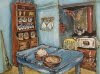
We can still buy homemade butter in Darling! One of the places where it is kept is in a fridge at the Darling Museum. It is a lovely pale cream butter, not as salty or as yellow as commercial butter, and it is wrapped in thick waxy paper. That is why I love these country museums, they truly keep traditions alive!
Saturday, August 11, 2012
Real Butter in Darling
We can still buy homemade butter in Darling! One of the places where it is kept is in a fridge at the Darling Museum. It is a lovely pale cream butter, not as salty or as yellow as commercial butter, and it is wrapped in thick waxy paper. That is why I love these country museums, they truly keep traditions alive!
Saturday, July 14, 2012
Orderly Cows
Cows in the countryside can contribute greatly to the sense of peace and order. I was amazed when I took the byroads near Darling, at how evenly they spaced themselves while grazing! They follow the contours of the land and each gives the other a fair area to work their way through the grass. Not only is there a sense of personal space that they respect; I remember from my childhood days that they would also move homewards in a row, with no pushing at all.
I had to relay the above thoughts about cows, but I promise to stop trying to be poetic, and be more practical in my next post! There is a famous dairy industry here, after all!
My paintings and photos from the last two posts show a scene that is familiar here, but also in many countries in the world! The gallery owner in Hopefield chose these beautiful frames for me, so that the scenes look timeless and could even have been from an earlier age!
Thursday, July 5, 2012
Nguni Cattle at Waylands
Avoiding the highway as usual, I often take the country road in order to observe some cattle. Waylands, a farm situated between Darling and Malmesbury will never disappoint. They have the most wonderful herd of cattle and some fabulous specimens of our famous indigenous Nguni cattle.
These beautifully individually patterned animals have been around Africa for centuries. They were famously used in the bartering-for-brides system. Today, they are the pride and joy of each farmer who owns them. To learn more about Nguni, visit Wikipedia, or the Breeders Association. Here is an amazing site dealing with their heritage, colours, etc.
I painted my canvas in a bright transparent yellow ochre first and proceeded from there, using only purple, ochre, sky blue, rust colour, black and white paints. My painting was chosen to hang in the Seasonal Changes Exhibition at Perels en Pampoene Gallery in Hopefield, that opens tomorrow evening.(022 723 1756)
Monday, August 15, 2011
10 Questions for West Coast Artist Marie Theron
10 Questions for Marie Theron
1. What place (in SA) do you call home, and why?
I live in a private nature reserve with my studio 80 m from the sea. This position was full of surprises when I first moved here and I slowly got used to the intensity of Nature. Storms are so totally overpowering that I am always reminded of the ships that were wrecked all along the West Coast. On the other hand one can experience a field of colourful wildflowers starting from our garden and stretching as far as the eye can see.
| Close to home... |
2. Favourite place to have breakfast near(ish) where you live?
Definitely SimonĂ©’s in Darling. Our attractive young restaurateur is always there to welcome you, smiling and chatting and busy as a bee, and the food is superb. The coffee is very good (important in the morning). Edit 15/08/11:This place is no longer in existence, but now we go to !Khwa Ttu, of course)
3. How does a working day in your life look?
I wake up with thoughts of a painting I am working on. Sometimes I will prop up my latest painting in the bedroom while I drink my coffee, to make sure everything is in balance. As my bedroom adjoins the studio I will often start painting whilst still in my night-clothes. A good day will have two sessions of three hours each for painting. I rest and read between sessions. Housework, gardening and blogging are all done in the periods in-between.
| Outside Marie's studio |
4. What is it about the West Coast that appealed to you so much that you decided to move there?.
The absence of traffic, the proximity of Nature; and because there are no high-rise buildings and few tall trees, the openness of the West Coast has a very special appeal.
| |
| A recent painting: 'Workers in Vineyard' - (near Malmesbury) |
5. Which SA artists work do you admire?
Peter Midlane’s paintings always stop me in my tracks. He has a true understanding of the South African landscape and puts it down without the sweet sentimentality one often sees.
6. What inspires you (in your work, every day, in life)?
I think to even become an artist in the first place; you have to be inspired by the lives of the Great Masters of Art. Whether they worked unrewarded and unacknowledged or found themselves prosperous, whether they died young for their country or lived to their nineties; whether weak and sickly or full of stamina and health: hardly anyone of them were idle or sat on their laurels! It was work at any cost!
| Marie's latest work - 'Arriving in Piketberg' |
7. When you’re away from SA what do you miss?
I determine to enjoy travelling and not spend my time longing back, but of course our ocean, our clouds, blue skies and indigenous flowers are the most beautiful.
8. Tell us, briefly, about a positive or unique South African holiday / travelling experience.
There are many of course, depending what you are looking for: the peace of the Highveld of Mpumalanga or the culture of the cities. I think Lamberts Bay is a lovely experience. The birdlife and sea and boats are magnificent. It is impossible to tire of the gannets. Who can ever eat too many crayfish? And for a Saturday evening with the sun setting way past eight, the Muisbosskerm is such wonderful and relaxed eating experience!
| Lambert's Bay - a lovely destination
|
9. Who is your South African hero, and why?
Can I change that to a town I admire? Then I will choose cheeky Darling, full of breezy confidence. They are as hard hit by the slump in the world economy as anywhere else, but there is no letting up, no slacking. A visitor can find something pleasant to do, somewhere to go almost any night of the week! You will always find smiling, positive people there.
10. Once you’ve run out of inspiration along the West Coast where will you be heading?
It is impossible to run out of West Coast material. I have hardly touched the sea and all it has to offer in critters, birds and boats. There is the San history and the Moravian missions. There are so many fynbos species (a painting of a special plant is coming up on my blog on Christmas morning.) The more I speak with people the more stories, places and legends of the West Coast are revealed, so hopefully I will just paint on and on…….
Sunday, July 17, 2011
Bambi Boerbok
Monday, October 26, 2009
The Marmalade Cat
Tuesday, September 22, 2009
Where will the road take us?
Friday, September 11, 2009
Coffee and Books

Thursday, September 3, 2009
Showtime in Darling

Friday, August 28, 2009
Exhibition in the Attic
Monday, July 27, 2009
Lilies of the Field
After the recent heavy rains the fields and valleys between Darling and Yzerfontein are green, and great clumps of arum lilies have opened along both sides of the road, the pure white flowers peeping out behind large arrow-shaped leaves. The rainfall here is limited to winters so that between April and September we may have from 125mm to 350mm of rain. No wonder the West Coast area of roughly 4400 km sq is the habitat of 1200 species of flowering plants. The arum lilies, Zantedescia aethiopica, are the first to appear before the advent of spring. Whether the motorist takes the time to take a look or whether he ignores them, they will freely offer their beauty from now on until almost January.
Is there anything on earth more calming than observing flowers? There are lovely words in the Christian Bible that everyone, everywhere should write onto the front page of their diaries full of appointments, tasks, lists and budgets. In plain and poetic verse it reminds us that we need not worry so much “:........Consider the lilies of the field, how they grow: they neither toil nor spin; and yet I say to you that even Solomon in all his glory was not arrayed like one of these. Now if God so clothes the grass of the field, which today is, and tomorrow is thrown into the oven, will He not much more clothe you......”
There is always a moment when one falls in love with a place, and my first memory of Darling goes back about 15 years, when I noticed lovely cows lying on top of a patch of these flowers. Darling, the town of milk and arums...............
Brownies, Anybody?

My husband readily agreed when I decided to paint SimonĂ©’s Restaurant with their outside staircase. I know why: he is absolutely addicted to coffee-and-dessert at Simone’s! So once he was settled in with his coffee and a soft-centered double chocolate browny swimming in thick warm chocolate sauce, I walked up to SimonĂ© and asked her to tell me something about the history of the attic, only to hear that there was nothing at all, the house was less than 10 years old!
“Marie,” she said, “the attic is not even in use”. I felt a tremor there and then! A beautiful new vacant attic above this excellent and popular restaurant would be the perfect venue for my exhibition! On the spot it was organised. So, starting on 28th August and going through September all the paintings on this blogspot so far, will be exhibited at SimonĂ©’s on Darling’s main street.
This was one of the nicest buildings I had to paint so far and I had 5-year old granddaughter Morgan as my assistent. She loved doing the feathery strokes for clouds and then patting them with her little fingers. After that she was very keen to help painting the ‘curly-whurly S’, but I squeezed out some bright colours and let her practice letters in her own book!
Monday, July 6, 2009
The Legend of Lelieblom Farm

“Once upon a time there was a large old shed.
The shed had saddles and bridles on its walls and crumbling paint which looked nicer than the most expensive paint techniques. But the shed was lonely.
Some walls went up, beloved and well-used antique furniture and carpets moved in and the shed became a homestead. But the shed- homestead was still lonely.
Tables laden with beautiful cloths, crockey and cutlery moved in. And from the kitchen came the sound of planning and cooking and the lovely flavours of food filled the atmosphere. Lots of people started to negotiate the dirt road between Darling and Moorreesburg and turned right at the Big Cross. They passed farm implements and parked very carefully because horses, a sow and her piglets and a large dog called Max were there to welcome them.The people entered the building and were overpowered by the friendliness and hospitality and wonderful aromas and happiness and they never wanted to leave again. The shed- house-restaurant hummed a happy and contented tune and wasn’t lonely anymore. The End”
I chose a little corner of the kitchen inglenook at Lelieblom Farm to paint. Everywhere you look, there is such a thrilling contrast of textures. At a Mother and Daughter Tea morning, my daughter Susan and I admired the charming show of dainty cakes and porcelain teacups laid out on a lovely worn Persian carpet. I recommend that you look at the Lelieblom website (just Google it) for photographs of the table settings and the unusual decor, menus brimful of hearty local food, and a listing of interesting future events.
Thursday, July 2, 2009
About Real and Ornamental Vines
Wednesday, June 24, 2009
Darling Museum and the Creamery Corner
Darling was founded in 1853 on a farm called Langfontein and named after Sir Henry Charles Darling, then Lieutenant Governor of the Cape. At the end of the Nineteenth Century a creamery was established here by Swedish settlers, Moller and Threnstrom.
A local lady, Baby Basson felt that the history of the creamery should be preserved and that was how the Darling Museum was started. Today, it is possible to spend many hours (or days) in the Museum with its well-furnished schoolroom, period furniture and porcelain, clothes, farm implements and even a shed with well-preserved antique vehicles. The main emphasis, though, is on the history of the creamery. What a wonderful idea it was to preserve this history and all these beautiful objects and utensils!
I prepared a stretched canvas with Naples Yellow acrylic paint, buffed it well, and then drew directly onto it with pen&ink. Afterwards I added highlights in white.( I am sure I have seen something Old Masterly like this technique but cannot remember where?) I am showing a butter churn made with a vat as base, milk cans and butter molds. The contraption in the back was used to seperate skim milk from cream. We had one when I was little and it was fun turning it each evening in the cool milk room and wait for the two different liquids to pour out. And why do I also remember that there was seventeen or so little dishes to wash and dry and stack back into each other?
Tuesday, June 23, 2009
An Antique Washing Machine
“It is an amazing sight to stroll up towards ‘Platteklip’ in the afternoon, and there watch the hundreds of dusky damsels lathering and wringing, banging and pounding our unfortunate garments in the brooks that come leaping down from ‘Table Mountain’. The bushes are covered for miles with snowy clothing; and these women are obliged to be up very early indeed in the morning to secure the pools for washing”
I love this piece, don’t you? It goes further to describe the little kids playing around the washerwomen.
I came upon this washing machine with a wooden barrel in our large Darling Museum. According to an online booklet : “history of washing” (P&G) , the middle of the nineteenth century witnessed the appearance of upright hand-powered washing machines with drums. Now that really saved the back as well as the hands of the laundresses! Unfortunately, at that stage washing detergents were still a long way off!
How to paint a washing machine in a museum? I found an image of a vintage poster for Persil and decided to paint it for the background. Those Persil ads were so clever: the pictures had clean lines and the colour scheme was limited to two shades of blue, a bright red and lots of pure white. The laundress shows cheeky blond curls, a pencil skirt, high heels and LOTS of make-up!
Friday, June 19, 2009
You are welcome, very welcome!
So let us rather gather our senses and take the West Coast road. Turn inland into Darling and when you reach the stop street at the main road, cross right over into Long Street. At the end of Long, turn right, and there you will find a truly welcoming entrance. Like the buildings of the olden times which had porticos and lanes to entice the pilgrim towards the main theme!
This is Ormonde Wine Cellars, where you will love the beautiful buildings of the homestead, cellars and tasting room. I love the open gate and the foliage only just hiding the buildings. And is there anything more welcoming and happy than our breezily optimistic National flag? Of course, you just know that the wine produced here, will be wonderful!
Thursday, June 4, 2009
Victorian Broekie Lace
On a sunny winter's day, I drive into Darling. Here, away from the ocean, the blue colour of the sky seems more intense. The homes in the older Victorian residential area are a joy to behold and I park here and there to take a walk. A profusion of foliage and deep dark verandas contrast with the light white walls and iron fretwork on some of the stoeps. This is overfeed of the senses and I realise that it is going to very difficult to condense this town into just a few paintings!
Victorian homes are relics from a time when curliqued designs and filigree castings were very popular. All hardware, including molded metal ceilings were made possible by the inventions of the Industrial Age. While Australians call the cast iron fretwork on verandas "Adelaide Lace", in South Africa, and I believe only here, we call it "broekie lace". Please, please do not translate this word as "panty lace" as it had nothing to do with such garments! I will explain:
Looking at pictures of Victorian ladies and little girls from about 1850 onwards, you will notice that they wore crinolene dresses in those days. A crinolene was a very wide dress kept wide with a petticoat with 8 hoops ranging from small around the waist to very wide at the bottom. These dresses could be lifted easily by the wind, thus long linen pantaloons underneath were a necessity. It was considered very dainty if young girls' pantaloons were slightly longer than the dresses and decorated with delicate lace. In Afrikaans, pants, jeans, pantaloons, everything is plainly called "broek". And the metal lace work on the veranda? Broekie lace!