Pages

Showing posts with label Yzerfontein. Show all posts

Friday, February 10, 2012

Facts of Flight # 1


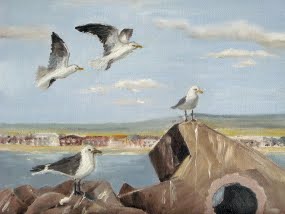
It seems nowadays that I cannot get enough of seagulls. I got up this morning at 5 to start planning some canvasses. Who me? Yup! I also went down to the rocks two nights ago to see them returning to their rocks. Seagulls leave in the late afternoon to drink water from a fresh source, such as the dams and rivers a few miles inland. On returning, their movements are at the most gracious as they glide in slowly towards their coming slumber. The guys I photographed in the sunset scene were still keen to dive down into the waves for morsels brought in by the strong tide, a little bedtime snack, I suppose!

The painting is somewhat similar to the one in the post about the dolosse. I love the juxtaposition of man-made boats, homes and dolosse with natural elements like rocks, water, clouds and birds. Painting size is 4oo mm x 4oo mm (15.7 " x 15.7 ") Oil on cotton wraparound canvas.


Friday, February 3, 2012

My Art is on the West Coast Route


I live on the West Coast, but now I am also represented in a much visited place along the route, the very special Nuweland Winery at Vyge Valley on the well-known R27 West Coast Route.

Today we hung 13 smaller works at Nuweland Winery and made wonderful plans for the future... including my participation in several Oyster Festivals and bringing in larger paintings! Invitations will follow!

Without much ado, here is the photo of the lovely venue for my art....with opening hours to suit everybody! That means seven days a week! For more info visit their website .

Sunday, January 29, 2012

Dolos, one amazing South African invention!


South Africans are naturally very innovative, and we are credited with some amazing inventions! Here I have painted one of the enormous dolosse along the Yzerfontein Harbour and jetty. They are made of concrete poured into a steel mould. So heavy are these structures that they are manufactured here in Yzerfontein or wherever they are needed. Cranes will lift them into place so that they can protect harbour walls and breakwaters and they also prevent soil erosion.10 000 dolosse are required for a kilometre of coastline.


I have to quote from Wikepedia here: "They work by dissipating, rather than blocking, the energy of waves. Their design deflects most wave action energy to the side, making them more difficult to dislodge than objects of a similar weight presenting a flat surface. Though they are placed into position on top of each other by cranes, over time, they tend to get further entangled as the waves shift them. Their design ensures that they form an interlocking, but porous, wall."Wow, the power of water and the cleverness of this invention!


Now, why are they called dolos ( plural: dolosse)? The form is similar to the neck bones of oxen. In the early days of our country, small children would pretend that these bones were their oxen to pull their tiny pioneer wagons. So they were called "doll oxen", which generated into the word dolosse.Then the word was also used to describe the bones thrown to read fortunes by the tribal medicine men, called sangomas. The act of predicting the future was more like "dobbel" which means "gambling". So those bones are still known as dolosse too.

These lovely structures, the theme of my painting and photos shows the third use of the word, and they do look like the neck bones of large animals. Grandson Philip was here from the States, and posed against the dolosse. He could not stop questioning his grandfather about these structures that can be stacked ANY WAY, yet they always fit together.


Elephant's Eye sent me their link to an interesting West Coast ramble that included a lot of information about dolosse. Read her blog HERE


After leaving a comment, you may want to visit some of our more important inventions HERE

Tuesday, July 27, 2010

The Beauty of Silence


The appeal of the West Coast lies in the great expanses of the landscape, the stark simplicity that is so easy to find around here. Follow our coast and you will see long stretches of pristine and lonely beaches. Sometimes there might be a man and his dog, a solitary angler, a backpacker!

Because it is winter here, I make use of photos taken by guest photographers. Today you meet the vibrant and well-known Yzerfontein personality, Mary Ann Bosch. She is an elegant and charismatic lady, darting around chatting, cooking and serving diners in their restaurant, Kaijaiki! She runs a B&B too. Because of her deep empathy with the human condition, she studies hard to be a life coach and will soon graduate in her course in Counselling and Communication. Her plan is open her own clinic in her peaceful seaside home near Yzerfontein. Also, with her first professional assignment as photographer, a Saldanha Bay wedding within a few months, she will once again have her hands full!

Busy, busy!!But to bring her whole being into balance , Mary Ann steps out on the beach with her camera, loving the early mornings and the time of dusk. She replenishes her soul in line with her motto: "I cannot give when I am empty." I thank her for the inspiration for this painting, from her photo of Langebaan lagoon that speaks so well of the "beauty of silence".

Monday, July 27, 2009

Lime Kiln at Yzerfontein


Before taking the R27 northwards along the West Coast, I crossed the road to inspect the lime kiln on the way to Yzerfontein. This one is a National Monument, well cared for by a caretaker whose cottage lies just behind it. Motorists may stop and enter the enclosure to see a close-up of one of the most important contributions to civilisation. I did not know this myself, but in Morgan’s Run by Colleen McCullough, (a book I have mentioned on this blog before), it is well explained: when a settlement starts, there are usually only wooden structures, and only if people could get hold of cement, could they start rising a town with proper buildings.

350 Years ago when the Dutch started the refreshment station at the Cape, they built these lime kilns to burn mussel shells to use as a binding material. It is built from limestone that can not crack and burst when heated and has a layer of mesh above the oven. Mussel shells, of which one can still collect by the ton full on Yzerfontein’s famous ‘sixteen-mile beach’, were layered with dry wood before the whole lot was fired. After some time the fine ash would fall through the grid. The enclosure where it was then mixed with water and left to dehydrate is also visible in my picture. The resultant stuff could be used for a binding material similar to cement. When mixed with salt, also found on the West Coast, and animal fat, it became thick pure white limewash to protect and embellish those lovely Cape Dutch and West Coast buildings.

The kiln was still used as late as 1976. There is also a one-third scale miniature replica of a lime kiln next to the Yzerfontein Tourism Buro building, the thatched building I painted in April and called A Rare Gem. I have loaded three paintings this morning. Be sure to read the other two stories below.

Saturday, April 25, 2009

An Yzerfontein Landmark


We are in Yzerfontein and have been admiring this well-known restaurant and guest house called Kaijaiki, which means 'small dwelling'. It was designed and built by the owners only twelve years ago. This is an example of how a sensitive design shows respect for the past and for the West Coast region. It helps us not to lose the old-world charm in a world where the older styles are discarded at too fast a pace. A building like this links with the vernacular to form a gentle passage between the old and the new.


People who has visited this blogsite will notice a new painting, as I have decided to show less roof area and get much closer. Here is that wonderful dark colour for wood called 'heritage green'. If you visit the historic buildings of the Cape the colour can be seen everywhere around windows and on wooden doors.


Once through the entrance you will experience the golden glow inside with it's lovingly collected cottage antiques that spell out that tried and tested saying: West Coast hospitality. Inside the dining area a real log fire takes you away from the stress of the city. Feast your eyes on objects from long ago, which even include Grandmother's sewing machine and her framed handmade bloomers.

And then, of course, you will meet your hosts, probably make friends for life, be offered the menu and an evening of relaxation can begin!

Friday, April 24, 2009

A Rare Gem (in the mist)


On a misty election morning in Yzerfontein, I expressed the need to find something that is man- made, but quaint and in the West Coast spirit in this town that has every gift Nature can offer in abundance, but has only modern homes. Our friend led us to this lovely cottage. The thatch roof and indigenous plants hug the building and make it look cosy and protected. The ridge on the roof is made by the proper chicken wire and cement method. Together with the always-present rocks of Yzerfontein, it frames a view of Meeurots. This will probably become one of my favourite spots from now on, and maybe I can take my artist friends there to paint, as to the left there is a one-third scale replica of a lime kiln, more rocks and more beautiful views.


Tuesday, April 21, 2009

Yzerfontein Vignette


From the highway, you go down to Yzerfontein waterfront, down, down, past the lime kilns (registered National Monuments), past the small CBD and the large 70's era houses. And there it is: one of the most beautiful stretches of water on the coast! The beach meanders on and on for many kilometers in both directions. Should you decide to walk this coastline from the harbour in the direction of Cape Town, you will see millions of birds, beaches with rocks for anglers, waves for surfers and a feast for the eyes for all. In the ocean you will notice the pretty guano encrusted little mound, aptly called Meeurots (Gull Rock), where seagulls and cormorants dry their wings after fishing. There is also a very close view of Dassen-eiland where penguins live and breed.

In this view we look back at the town. Man-made breakwater rocks are added to the large natural rocks to build a safe landing passage for returning fishing boats. Alert gulls on their cluster of rocks keep an eye on the returning yield and form a frame for the scene behind them, a composition that helped me to overcome the awkward square form of the canvas.

Monday, April 13, 2009

Old Fish Market at Yzerfontein


I loved observing the scene of the old fish market at Yzerfontein. The dirty yellow guano- incrusted building electrified the atmosphere. Loud-mouthed locals would beckon their customers in friendly competition with each other. Witticisms would fly around like the ever-present seagulls. The fare was usually fresh snoek, geelstert, red roman or great amounts of the small hottentots fish. Visiting the fish market was only the beginning of a lovely evening......
Nowadays there is a new fish market, widely promoted while it was being built. We go there in anticipation, only to realise that 'of-fish-cial-dom' rules. The facilities are for cleaning and gutting, but selling is not allowed. The public is unwelcome and the fishermen are unfriendly. An enquiry about buying is ignored and everyone must re-think the concept: market.